Professor Hao Sun's Team at the Gaoling School of Artificial Intelligence Publishes a Cover Article in Nature Computational Science
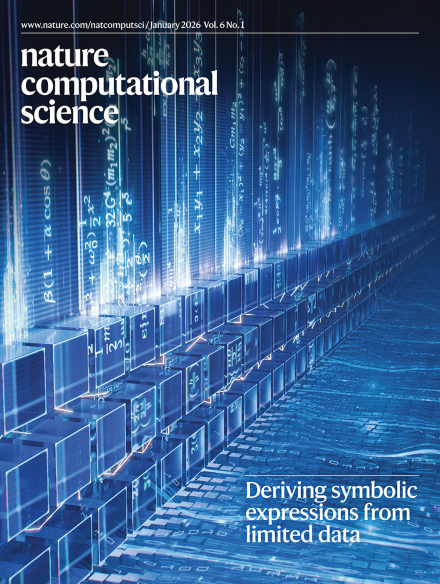
Recently, the research team led by Professor Hao Sun of the Gaoling School of Artificial Intelligence at Renmin University of China published a paper titled "Discovering physical laws with parallel symbolic enumeration" in Nature Computational Science. The paper was selected as the cover article for the journal's first issue of 2026 (Volume 6, Issue 1).
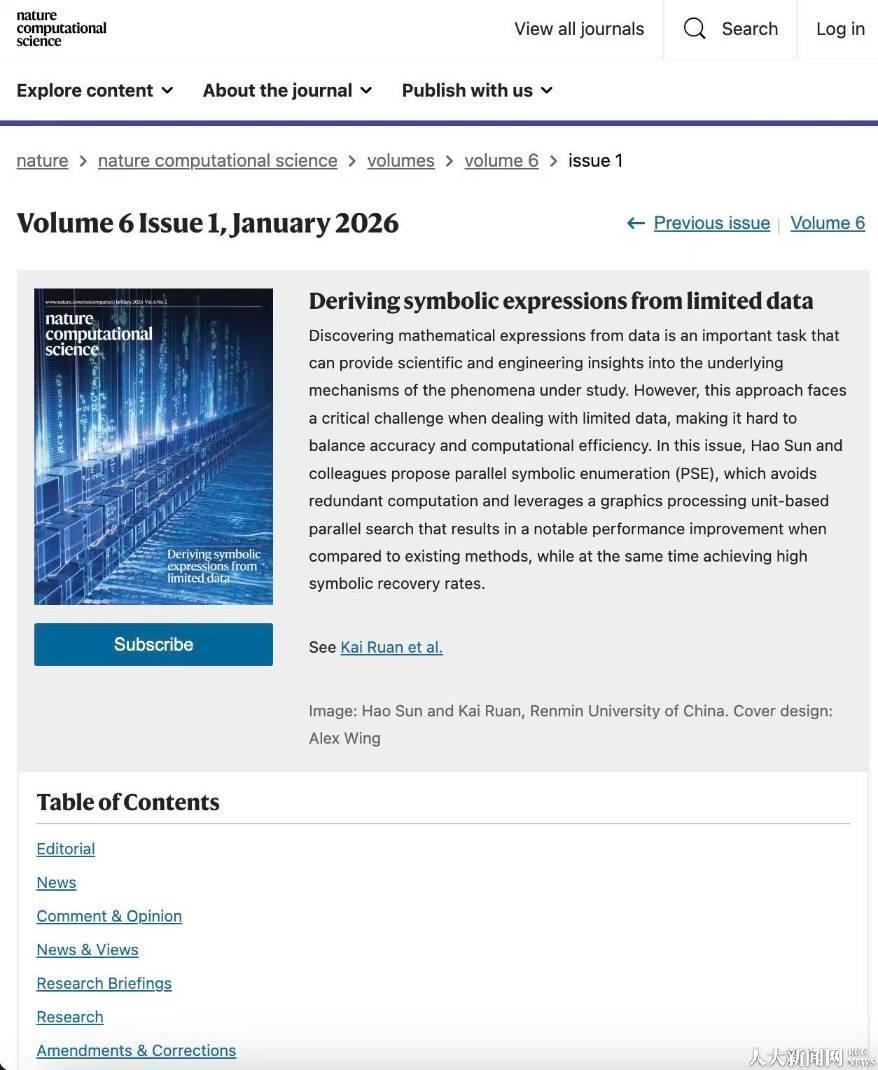
The journal commented: discovering mathematical expressions from data is an important task because it helps researchers gain deeper scientific and engineering insight into the underlying mechanisms of the phenomena under study. However, when only limited data are available, this approach faces a key challenge: balancing accuracy with computational efficiency. In this study, Hao Sun and his team proposed Parallel Symbolic Enumeration (PSE). By avoiding redundant computation and leveraging GPU-based parallel search, the method achieves a high symbolic recovery rate while delivering substantially better performance than existing approaches.
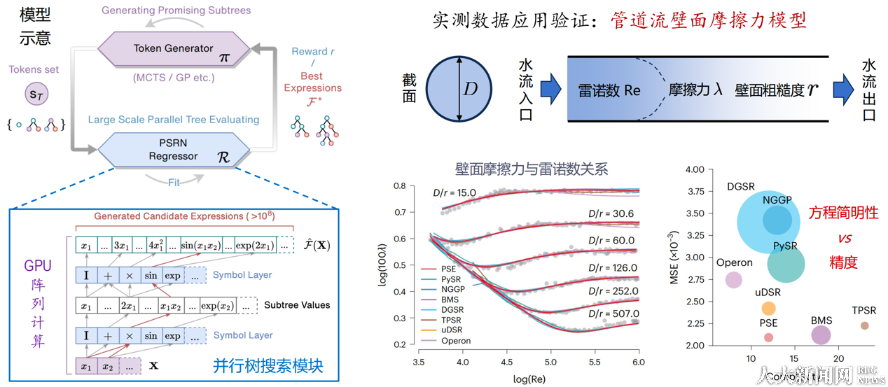
The research team systematically evaluated PSE on more than 200 symbolic regression tasks spanning synthetic benchmarks and real-world physical experiments, including chaotic dynamical systems, electromechanical positioning systems, and turbulent friction laws. The experimental results show that, compared with current leading international algorithms, PSE improves symbolic recovery accuracy by as much as 99% while running more than an order of magnitude faster, demonstrating exceptional accuracy, efficiency, and scalability. This work provides an efficient and scalable computational framework for data-driven scientific discovery, opens a new pathway for the automated exploration of physical laws, and is expected to accelerate scientific research across interdisciplinary fields including physics, materials science, astronomy, and biology.
This research was supported by the National Natural Science Foundation of China, the Beijing Natural Science Foundation, and the Renmin University of China Research Fund, among other sources.
Nature Computational Science, published by Springer Nature, is a leading international interdisciplinary journal with an impact factor of 18.3, according to the original article. The journal is dedicated to advancing innovative applications of computational technologies and mathematical models across multiple disciplines, covering frontier research from bioinformatics and materials science to computational social science. It publishes high-quality algorithms, tools, and methodological advances that promote scientific discovery and address practical challenges.
Paper: K. Ruan, Y. Xu, Z.-F. Gao, Y. Liu, Y.K. Guo, J.-R. Wen, and H. Sun. "Discovering physical laws with parallel symbolic enumeration." Nature Computational Science, 2026, 6(1): 53-66.

Professor Hao Sun: Hao Sun is Vice Dean and a tenured professor at the Gaoling School of Artificial Intelligence. He is a recipient of a national high-level young talent program, earned his PhD from Columbia University, and completed postdoctoral research at the Massachusetts Institute of Technology. His honors include Forbes North America's 30 Under 30 list in Science.
Research Areas: AI for Science, intelligent scientific computing, physics-informed machine learning, and physical spatial intelligence. Focusing on the needs of knowledge embedding and knowledge discovery, his research develops new theories and methods for intelligent scientific computing that are generalizable, interpretable, error-controllable, and less dependent on large datasets, while promoting applications in interdisciplinary settings.